 VEYLO
VEYLONose
Nose: try rhinoplasty styles and filler on your own face
Pick a rhinoplasty style and strength, try nose filler in millilitres or narrower nostrils in millimetres — on a 3D scan of your own face, from the front and from the side. Then take specific questions to a qualified surgeon.
Free · No account needed · iPhone with Face ID


A visualization, not a prediction.
Rhinoplasty, nose filler and nostril narrowing
Rhinoplasty is surgery that reshapes the nose — for example lowering a hump on the bridge, raising a low bridge or changing the tip. Nose filler, sometimes called a non-surgical or liquid rhinoplasty, is a hyaluronic acid gel injected to even out the profile; it only adds volume, so the nose becomes slightly larger, not smaller. Nostril narrowing (alar base reduction) removes small wedges of skin at the base of the nostrils.
Which option, if any, suits you depends on your anatomy, your skin, your breathing and a surgeon’s assessment. Swelling after nose surgery settles over months, and only an in-person examination can tell what is realistic for you.
In Veylo, rhinoplasty is a style — straight bridge, scooped bridge, lifted tip, refined tip or raised bridge — at a subtle, moderate or pronounced strength. Nose edits change only the nose: lips, eyes and brows stay exactly as they are. Bridge and tip height show best in the side view, which needs the 3D scan.
Nose changes on sample faces, original and visualization.
Sample face

Choose an area
Listed from least to most invasive. Information, not a recommendation.
Nose
Add treatment
Listed from least to most invasive. Information, not a recommendation.
Rhinoplasty
Soft-tissue surgery · Surgical
Typical in published studies:
Nose–lip angle approx.
+8.0°
Rhinoplasty · Lifted tip · Moderate · 6°
Rendered by the Veylo face engine on AI-generated sample faces — not patients. Millimetres are approximate, on Veylo’s visualization scale. A visualization, not a prediction.
Five rhinoplasty styles, at three strengths.
Each style is a neutral description of a common change. Pick one and a strength — subtle, moderate or pronounced — in millimetres or degrees. Styles are listed, never ranked or suggested for a face.
Straight bridge
A smoother, straighter bridge with the tip kept where it is.
Subtle1.5 mmModerate3 mmPronounced5 mmScooped bridge
A gently curved, lower bridge that dips before a lifted, defined tip. Often called a “ski-slope” nose.
Subtle2 mmModerate3 mmPronounced4.5 mmLifted tip
The tip sits a little higher, showing a touch more of the nostrils.
Subtle3°Moderate6°Pronounced10°Refined tip
A narrower, slightly lifted tip. The bridge stays as it is.
Subtle1 mmModerate2 mmPronounced3 mmRaised bridge
A higher bridge that starts a little higher between the eyes.
Subtle1.5 mmModerate3 mmPronounced4.5 mm
Bridge and tip height show best in the side view, which needs the 3D scan. Narrower nostrils combine with any style. A visualization, not a prediction — swelling settles over months.
Amounts in real units, with the ranges studies observed.
Move the slider to see how Veylo sets this treatment. The shaded band is what published studies observed — context, never a recommendation.
Seen in studies: 0.1–1.5 ml total
Outside the range seen in published studies. Talk to your clinician about what is appropriate for you.
Approx. change on Veylo’s visualization scale
Source: Retrospective review of 2,088 nose-filler cases, Plastic and Reconstructive Surgery – Global Open. Mean 0.49 ml per session. The band of 0.1–1.5 ml covers the amounts reported across the studies Veylo’s research cites.
Slider in the app: 0–1.5 ml, in steps of 0.1
Seen in studies: 1–3 mm per side
Outside the range seen in published studies. Talk to your clinician about what is appropriate for you.
Approx. change on Veylo’s visualization scale
Source: Study of combined alar base excision, Archives of Facial Plastic Surgery. The slider sets the change in nostril width per side, about 1–3 mm in the literature — not the width of the tissue removed, which is larger.
Slider in the app: 0–4 mm per side, in steps of 0.5
Ranges show what published studies observed. They are not a recommendation; your clinician decides what is appropriate.
What Veylo shows
- Five rhinoplasty styles at three strengths, in mm or degrees
- Nose filler in ml and narrower nostrils in mm per side
- Front, side and 3D views — bridge and tip height show from the side
- Nose changes combined with lip or chin treatments in one plan
What only a clinician can tell you
- Whether surgery, filler or neither is suitable for you
- What is realistic for your nose, skin and cartilage
- Whether your breathing could be affected, and how that is checked
- Risks, recovery and how long the swelling takes to settle
How it works, in 3 steps.
- 1
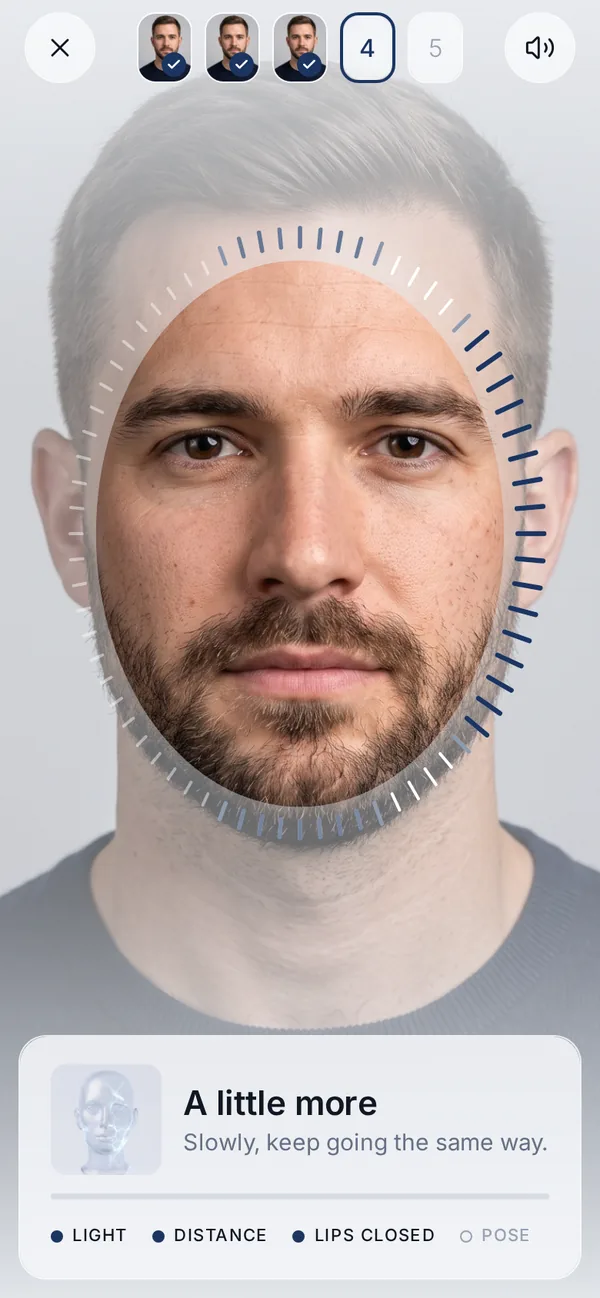
Scan your face
Five guided angles with the iPhone’s TrueDepth camera, about 40 seconds, with voice guidance. Your face data stays on your iPhone.
- 2
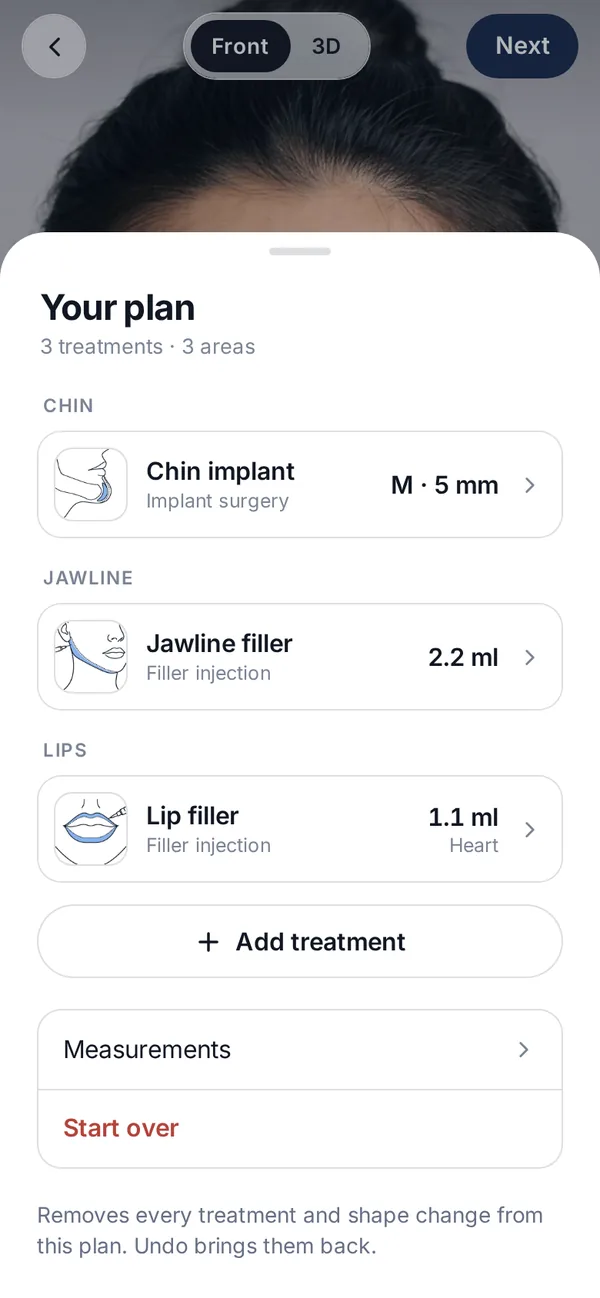
Set the treatment and the amount
In ml, mm, units, an implant model and size, or a style. Combine treatments in one plan; only the areas you choose change.
- 3
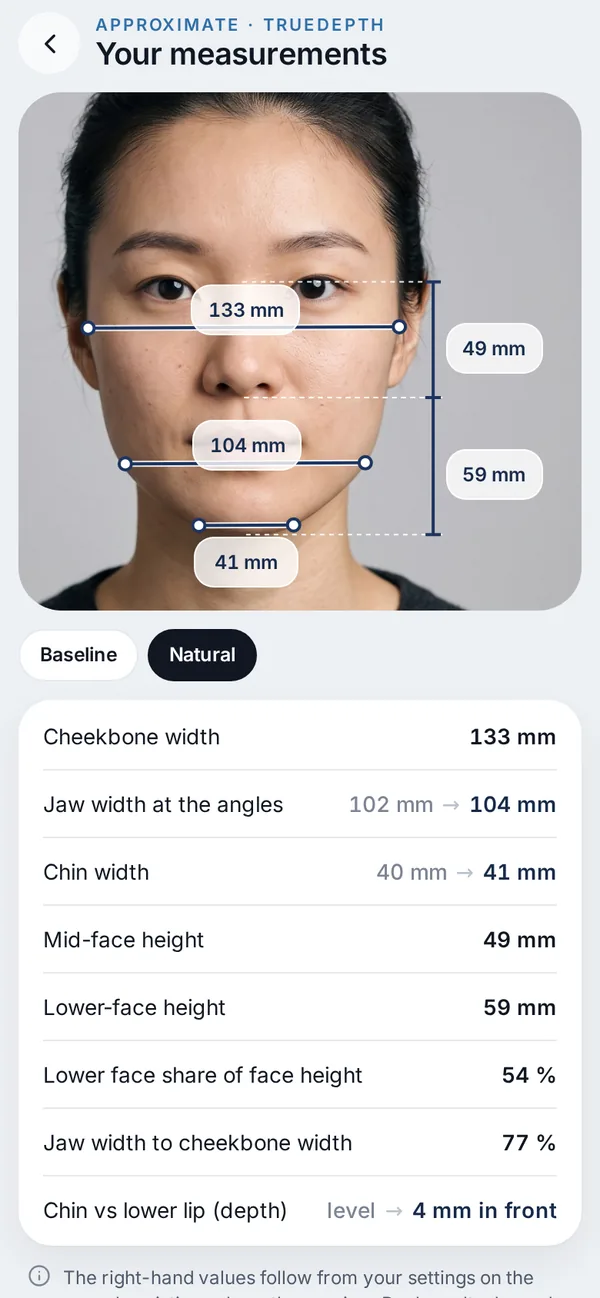
Compare, then talk to a clinician
Original and visualization side by side, with approximate millimetres — and an optional private link for your clinic, with your questions.
Questions about nose: rhinoplasty & filler
Which nose style would suit me?
Veylo cannot tell you that, and it never ranks or suggests styles. The styles are neutral descriptions of common changes, so you can see them on your own face and ask a surgeon about them.
What is the difference between rhinoplasty and nose filler?
Rhinoplasty is surgery and can make parts of the nose smaller or larger. Filler is injected and temporary and only adds volume — it can smooth a profile, but the nose becomes slightly larger, not smaller.
Why does the bridge look almost the same from the front?
A front photo cannot honestly show bridge height — a hump or a raised bridge shows mainly in profile. Switch to the side view (it needs the 3D scan) to see bridge and tip height.
Does Veylo show my result after rhinoplasty?
No. It shows an appearance visualization from your scan. Swelling settles over months, and healing, skin thickness and cartilage shape the real result — none of which an app can predict.
How much nose filler is used?
As context, a review of 2,088 cases reported a mean of 0.49 ml per session. How much, if any, would be appropriate for you is decided by your clinician.
Can I combine nose and lip changes?
Yes. A plan can hold treatments from several areas. Nose edits never move the lips, and lip edits never move the nose. Whether a combination makes sense for you is a clinical question.

Try treatments
before you book.
Free on iPhone with Face ID. No account needed to scan and edit.
Not ready for the beta? Get an email when Veylo launches.
A visualization, not a prediction.
Related treatments you can try in Veylo.
 LipsLips: filler, lip flip & lip liftLip filler styles in ml, lip flip in units and lip lift in mm.Read more
 ChinChin implantReal implant models and sizes from manufacturer catalogues.Read more
 CheeksCheek filler & buccal fatCheek filler, buccal fat removal and cheek implants.Read more
 For clinicsVeylo for clinicsFor aesthetic clinicsRead more